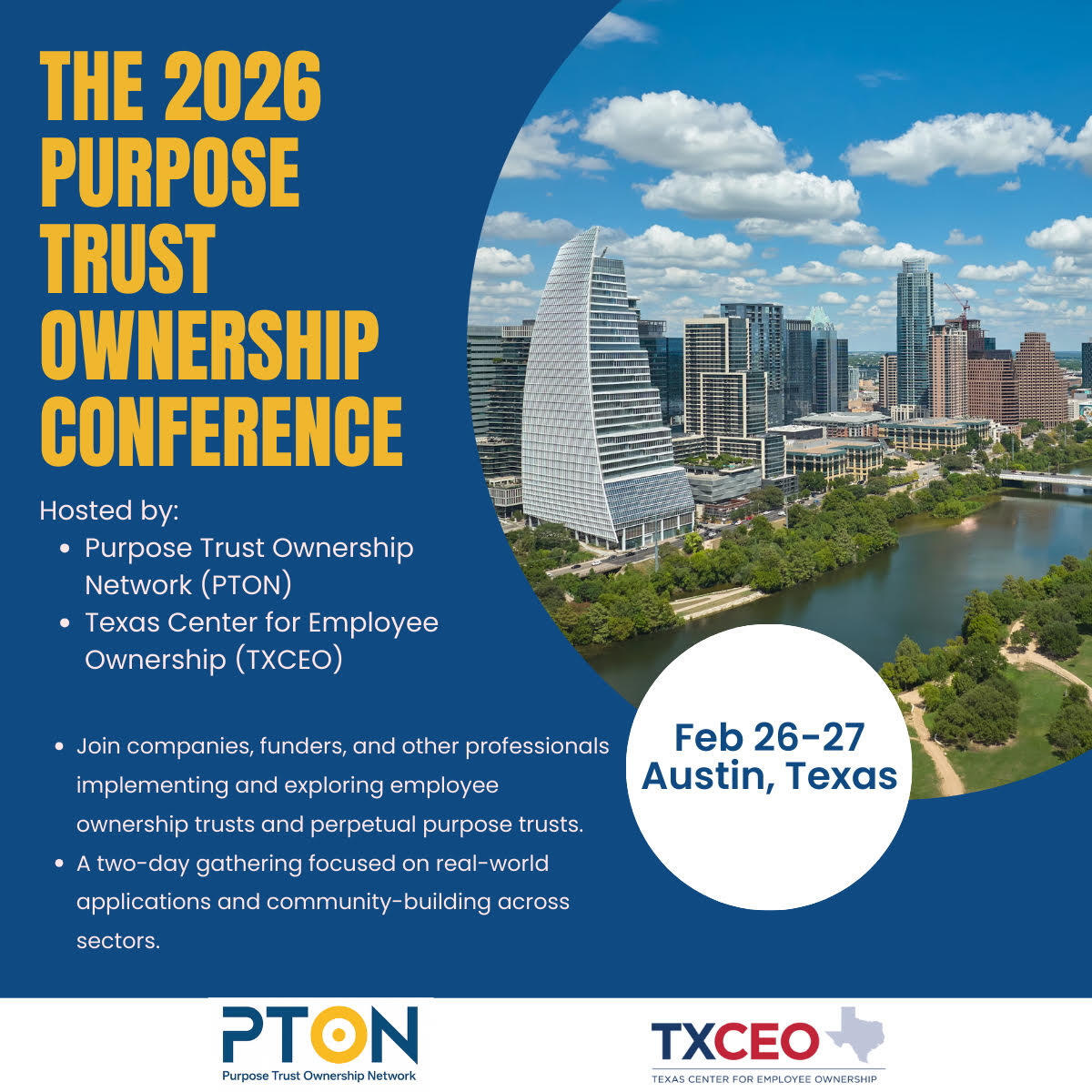
Last week, we brought 150 people to the first Purpose Trust Ownership Conference in Austin, TX. I was grateful and honored to be invited to offer the closing keynote. You can read the draft below or listen to the (AI edited) speech here:
In a recent book, Native American author Steven Charleston chronicles the lives of four prophets who foresaw, and helped their communities survive, the apocalypse of European colonization. From their history, Charleston draws four lessons for dealing with times of radical, potentially apocalyptic change. I’ve been thinking about those this week, amid wars and rumors of wars, and especially how much this community of people embodies what Charleston hopes for.
First, Charleston says, radical change demands a radical response--turning the culture upside down. As Jason Wiener put it last night, the proximate cause for our gathering is a legal form. But the deeper cause is that all of you are doing just that--turning over culture.
Second, the crumbling of the world we know demands that we build prototypes, or lighthouses, of an alternative potential future. That is who you are. Patagonia may be a national lighthouse, sure--but it’s you, in your towns and in your industries--that are prototypes of alternate futures.
Third, it is imperative that we take into consideration the stakeholders that have historically had no voice or power in our economies. Smoholla, one of Charleston’s four prophets, asked during a negotiation with the Europeans “I wonder if this land has anything to say?” Surely you hear this and think of Organically Grown, or Local Ocean, or the other companies here that are taking their environment--our environment--seriously.
Fourth, building a future together means just that--building a future together. As you heard from Issie yesterday, this is built directly into PTON’s DNA, and it’s what I see in most corners of the wider world of alternative ownership. It is a collaborative vision that Natalie Reitman-White had a decade ago, that has finally taken root. And it is, as we talked about in our ecosystem panel yesterday, deeply pluralistic--I guarantee you there are companies here whose purposes you would disagree with. But I think we know that we are building an alternative future, together, and that has to happen, together.
I took a lot of comfort in the historical depth of Charleston’s We Survived the End of the World. As Ari reminded us yesterday, learning history keeps you from getting caught with your pants down. I’m paraphrasing — Ari may have said it with more dignity than that. Actually, knowing Ari, probably less.
I’d like to take one more historical detour, if you’ll allow it. Joseph Blasi told me last week about the New York company B. Altman and Company. Unless you’re of a certain age, you probably haven’t heard of it. But for over 100 years, the Manhattan-based retailer was a purpose-driven, charity-spawning, gender-bending high-end retailer in New York. When Benjamin Altman died in 1913, he left his stock in the stores to the Altman Foundation, creating what was essentially a purpose-driven ownership structure: the department store funded charitable and educational work in New York City, and everyone who shopped at Altman’s was also contributing to local charity efforts.
This arrangement worked for over seven decades. But then came the Tax Reform Act of 1969’s excess business holdings provisions, which restricted private foundations from owning active businesses. The Altman Foundation had to divest ownership, the company traded hands a few times, and then finally shut down in 1989.
This story stuck with me in part because it is representative of the fact that if we widen our aperture just a little bit, we can see history littered with examples of founders that were trying to do things differently, but ultimately failed.
For the Louisville Courier-Journal, a family feud with no succession structure handed one of the ten best newspapers in America to Gannett for $300 million, and was immediately enshittified. HealthTrust, A 104-hospital ESOP dissolved its employee ownership structure within four years, then sold to Columbia/HCA, which later pled guilty to 14 felonies and paid over $2 billion in fraud penalties. Three private equity firms bought Toys R Us, a profitable company holding 20% of the American toy market, loaded it with $5.3 billion in debt, collected $470 million in fees, and >30,000 people lost their jobs. At Cadbury, over the objections of the board, the employees, and the British government, shareholders ended 186 years of Quaker values in a Kraft Foods boardroom, and ruined Cadbury Creme Eggs for a generation.
These founders had all “built something worth protecting,” but did not have access to the architecture they needed to support their good intentions.
It’s that architecture that we are building today. And already, in just a few short years, look what we see: For every Louisville Courier-Journal, there is a Berrett-Koelher Publishing that shows how else publishing can be done. For every Healthtrust, there is a LiveOak Living. For every Polaroid, and Optimax. For every Toys R Us, an Entertainer — a British toy company whose founder just chose employee ownership over private equity last September. For every Cadbury, a Tony’s Cholonely. Each of these companies has built something worth protecting, and it is the people in this room that have helped them figure out how to protect it.
I first came to know about purpose trusts in 2021, thanks to a nudge from Zoe, a longtime friend of mine. Many of you had already been doing the work by then. But it was clear that many more hands were needed for this model to reach a scale proportional to the size of the problems we seek to solve. It was Jenny Everett who helped me understand this as an ecosystem problem, and it is what we set out to help solve.
In the academic literature — bear with me, this is the last time I’ll try to sound like a professor today — there are two camps on entrepreneurship. One camp says entrepreneurs discover opportunities. The other says they create them out of thin air, by putting out a quarter-baked idea and seeing who shows up to build it with you, and now you have a half-baked idea. PTON is firmly in that second camp. Natalie had had a quarter-formed idea. You showed up. And now look at this room. Ten years ago we could have held this gathering in a single booth at El Cockfight--a small one! But here we are, a room full of 150 people and 100 more we couldn’t pack in. We have gotten here in collaboration with you, and the vision of PTON is self-consciously a recombination of the skills, networks, knowledge, resources, and needs that you have shared with us.
The task moving forward, I believe, is the same: to find new friends, share with them our half-baked idea of what the future could be, and let their skills, networks, knowledge, resources, and needs reshape what we are building. As Charleston’s fourth Native American prophet demonstrated, the future can only be built together--co-created. We can’t do that without you, but with you, we are confident that we can co-create that better, alternative future.
I’d like to close with gratitude. Simone Weil said “attention is the rarest and purest form of generosity.” I am grateful, we are grateful, for your generous attention these last few days. I’d also like to thank Issie and PTON, Taylor and TXCEO, and our funders and speakers. And a special thanks to the volunteers and staff at The Line who made this happen. So let’s get some lunch, and then let’s get to work.