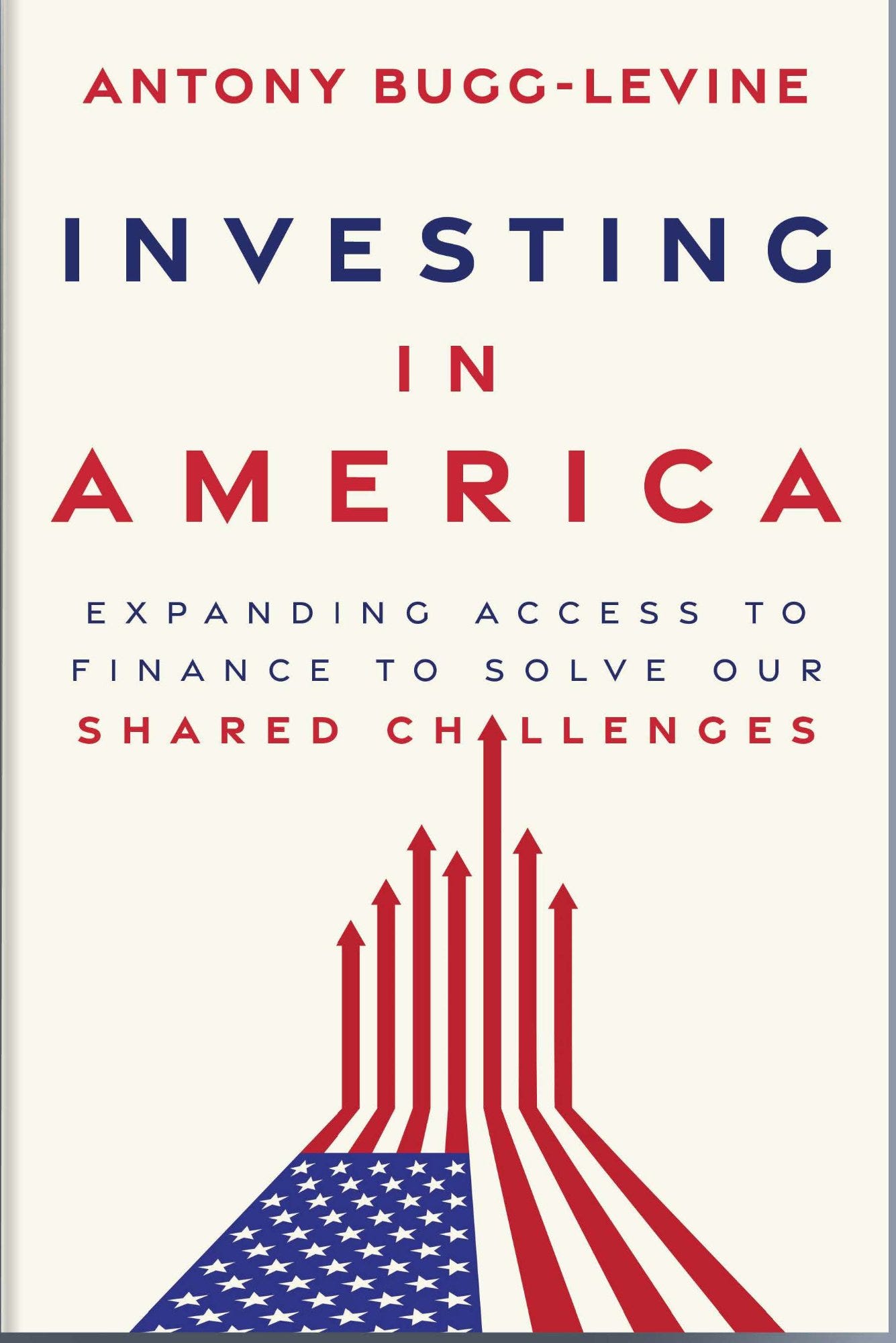
Antony Bugg-Levine, co-founder of the Global Impact Investing Network, recently published a new book: Investing in America. The book features multiple stories of employee-owned firms and lessons for employee ownership advocates.
🥃 Top Shelf Insights
On the importance of language that invites people in, from someone who helped coin the term, impact investing: “We too often use language that prevents people who could be our allies from working with us…I just think every minute you spend debating definitions is a minute you’re not spending figuring out how to get more workers the capacity to own the companies they work in.”
On connecting with other movements: Growing employee ownership “has to occur within a much broader shift in how our society understands the role of capitalism and ownership in general. For centuries, the right to incorporate a business was given as a privilege in order to enable groups of people to come together to invest in something that was good for society…We just happen to have lived in this weird time in history where that’s been forgotten.”
On finance as the obstacle to the growth of employee ownership: “I think this is one of the main reasons why employee ownership is stalled. The challenge of the financing of employee ownership is how to create a level playing field, in which workers have the same access to financing the way the private equity guys, the strategic buyers, and the rival companies do…It’s just the workers are shut out of that.”
On the importance of market shaping and crowding in mainstream capital: “If your vision is a world in which every worker has a chance to buy their company, then let’s do the math: What would it take to finance the acquisition of every company in America and transition them into employee ownership? The numbers would get into the trillions… At the end of the day, you are going to have to get financing from people whose motivations are not impactful, but who simply want to make reasonable investments… where the structures have been created around them so that is a logical decision for a profit-maximizing investor to do.”
The Full Interview
In addition to co-founding the Global Impact Investing Network. Antony Bugg-Levine is a senior fellow with LSE’s Marshall Institute and fellow with Renaissance Philanthropy. His earlier book with Jed Emerson, Impact Investing, remains a staple in impact investing courses around the world. And he just published a new book, Investing in America: Expanding Access to Finance to Solve Our Shared Challenges, which includes stories of—and lessons for—employee ownership. You can find the condensed interview here.
Kate: Antony, you’ve had an extraordinary career coming from Apartheid South Africa to the Ivy Leagues to working with farmers in Uganda and Kenya to the Rockefeller Foundation, and then convening the conference that coined the phrase “impact investing” and founding the Global Impact Investing Network. So how did you come to employee ownership?
Antony: First of all, thanks so much for having me. It’s a real pleasure to be on The Stakehold. You guys are small and mighty. We have an employee ownership beat reporter, and that’s so important. I’ve seen it in other fields as well: To just be able to have a conversation which is not at 101 and introducing a concept, a conversation that can actually get more into what it’s really gonna take to realize the potential of employee ownership…It’s super exciting.
To take one step back from your question, how did I end up being excited by employee ownership, the trajectory of my career and my adult life helps provide the foundation of that answer.
I’m South African originally. I came here when I was young. I was in college when Nelson Mandela became president of South Africa in 1994. I graduated in 1996. I moved back. We had a new constitution in 1996 that was passed a few months after I returned home, and we were the free-est people the world had ever known on paper.
I ended up working in the South African Human Rights Commission. There was a group of farmer laborers up in the north of the country who sent in a complaint to the Commission saying, Please come investigate. We are being terribly oppressed.
And really horrible stuff was happening. What that really crystallized for me was this realization that even though on paper we were the freest people that the world had ever known, in reality, because those people in that community had no economic power, they had no ability to realize their rights.
All the jobs were controlled by the farm owners who were still the white people who owned the farms under Apartheid. The stores were owned by those same people and their families. You couldn’t bank in a bank unless you were banking in one of their banks.
So, long story short, in my career I ended up taking a series of steps to help create the conditions in which more people get to have the economic power that we ultimately need, to be able to realize those rights. You know, both are necessary, and alone, they’re insufficient.
Economic power without a strong constitution doesn’t give you freedom, but neither does a great constitution with no economic power, in the capitalistic systems we live in.
The more I learn about employee ownership, to answer your question directly, the more clear to me that this is a public policy miracle. This is a negative calorie milkshake. And what I mean by that, there are not a lot of things in this world in which truly everybody wins. It’s either gonna be not tasty or it’s gonna be not healthy.
Employee ownership is both. The data’s really clear: It’s great for employees, when it works, it’s great for the people selling the companies in the U.S. because of the tax breaks if you’re using an ESOP, and in other ways with other structures. It’s great for the economy. It’s great for our democracy, which, by the way, Benjamin Franklin also said, that business owners make good citizens.
So that’s why I’m excited. And the question I keep getting is, why is this not bigger? With a lot of other policy issues, that’s not the first question. The question usually is, does this really work? Can it work, who wins, who loses? But the question I keep getting with employee ownership is, why is this not bigger, and we should get into that.
Kate: We definitely will. But this is the perfect segue into your new book, Investing in America. Tell our readers about it, why they’ll find it as compelling as I did.
Antony: Yeah, thanks so much. People will ask, “What does it mean to invest in America?” I’m talking about the act of using for-profit investments to expand who has access in this country, to turn their towns, hard work, and opportunities, into progress for themselves, their community, and our country.
And to answer the question, what does it mean to invest in America, I will go back to Benjamin Franklin.
In 1789, Benjamin Franklin is living in Philadelphia. He’s just returned from years in Europe. Months after the Constitution of the United States gets passed, he amends his will where he creates a loan fund to enable workers to become owners. It’s amazing. You can see it in that incredible 18th-century handwriting. Or you can read it in more of a legible form.
Now 83 years old, he says, “When I came to Philadelphia as a young man, two friends arranged a loan. And the loan allowed me to start my own print shop..”. He took the skills he had learned working for his brother. He saw an opportunity, from a business perspective, to start that business in Philadelphia, but what he didn’t have was the startup money for the business.
He describes a loan as the foundation of his success and all good that can be ascribed to him. This is one of the founding fathers of America. There’s a lot of good that can be ascribed to him. And he’s one of the richest. We call him a media mogul now based on what he built. All of it, he says, results from the fact that two friends arranged a loan that allowed him to start a business, take the skills he had learned as a laborer, the opportunity he saw, his ambition, his hard work, and turn it into a successful business and a successful life.
And in order to pay it forward–he doesn’t use that language, but that’s what he did–he took £1000 sterling in Boston, and £1000 sterling in Philadelphia, and created revolving loan funds to provide start up capital for new businesses.
This is the core idea of my book: There are so many times in our lives as individuals, whether it’s when we got into college, when we wanted to buy a home, we wanted to buy a car, where, unless we were one of the few incredibly privileged people in this country who have that cash up front to do those things, we need someone to provide us with loans–all of which allow you to have a better life and to make more money, which allows you to repay the loan. But you need a loan because you don’t have the money up front, just like most workers do not have the money to buy the company they work for.
So this idea Benjamin Franklin had, that you could completely transform the life trajectories of people just with a small startup loan, given to the right person at the right time–That’s the spirit of Investing in America.
And it’s not just around giving workers’ loans to start businesses. It’s also about providing non profits with loans to buy 100,000 acres of forests in the Appalachians, which they can then steward for multiple generations. It’s about getting people, who can’t qualify for student loans because they don’t have parents to cosign, a non-exploitative loan that allows them to finish a four year college degree. It’s about getting homeowners who can’t afford a 20% down payment, an investment partnership that allows them to buy their first home in an affordable way, and own at least a part of an appreciating asset.
So the book is about that spirit of operating like Benjamin Franklin did, and finding innovative ways to provide fair financing, so that people can turn opportunities and hard work into progress for their families, their communities, and our country. It’s happening all over the country, and it’s a powerful tool we need to harness, to solve a set of national challenges that most of us can agree on. This isn’t about being Democratic or Republican, or coastal vs. heartland.
Kate: Let’s get into the financing of employee ownership. You have a chapter in the book on protecting our natural resources where you observe that, “Solutions often require upfront costs that few community members or service providers can afford while generating long term financial benefits that they cannot wait for.” How do you think about that same lag in the employee ownership space and the patient capital required in transitions?
Antony: Yeah, this is the heart of what I mean by Investing in America and it’s the same with employee ownership. Most people who work in a company do not have the money upfront that it takes to buy the company. When you buy a company, you are buying the discounted value of all their future profits. That’s what the enterprise value of any company is. And if you’re a worker in one of those companies, you’re helping to produce those profits over the years, but you don’t have access to them in your bank account to cover the transaction.
I think this is one of the main reasons why employee ownership is stalled. The challenge of the financing of employee ownership is how to create a level playing field, in which workers have the same access to financing the way the private equity guys, the strategic buyers, and the rival companies do. They have connections to institutional investors, or they can go get a bank loan or issue bonds. So, it’s not that other people aren’t finding ways to finance these acquisitions. They are. It’s just the workers are shut out of that.
And I truly believe most owners, with all else being equal, would rather sell to their workers than any other scenario.
So I don’t think the financing question is the only answer to what we need to do to expand employee ownership, but it’s certainly a big part of it.
We ran an experiment for 50 years in America: If we provide massive tax privileges to the owners, massive tax privileges to the workers, but we don’t solve the financing piece, will that be enough to grow employee ownership in America? And it’s time to declare the experiment over. It didn’t work.
Kate: Right. And banks aren’t necessarily set up to underwrite to a group of employees, some owners need liquidity now and can’t wait on a seller note…You observed that financing isn’t the only thing we need to be doing to grow employee ownership. What else do you see?
Antony: A lot of people have been doing a lot of work on this for a long time. Awareness is an issue. We certainly need to expand the understanding in our country that this is a viable option for more people. It’s just not part of the median business owner’s understanding.
It also has to occur within a much broader shift in how our society understands the role of capitalism and ownership in general. We happen to live in a very unique moment in time, decades where the notion of shareholder privacy has been the dominant intellectual paradigm. People now absorb it like a fish absorbs water. You don’t even see it around you. You just think it’s the only way things could be.
But of course, in the history of capitalism, it is not normal to assume that the only purpose of business is to maximize financial returns, that there is no obligation of a business owner to its community. That is a new idea that was promulgated, starting in the 1970s.
For centuries, the right to incorporate a business was given as a privilege in order to enable groups of people to come together to invest in something that was good for society. So there was an understanding that the corporations should exist, not just to enrich their shareholders, but also to create some better social purpose. We just happen to have lived in this weird time in history where that’s been forgotten.
So I think at a very high level, we just need to reconnect this idea. I like the phrase shared prosperity, and this idea that we have both an obligation and an opportunity in America to share the prosperity of this incredible economy more broadly. If that again became a more dominant foundational part of how people think, then that’s more fertile soil for that employee ownership seed to be planted.
That’s at a very high abstract level. I’m running away from the question a little bit, because there are a lot of people who read The Stakehold who know the answer to this question better than I do, all the things that have to happen. Clearly there’s a lot of regulatory reform, the transaction costs, the legal liabilities and risks that come with ESOPs that do make them take longer, cost more, and become riskier to sellers than would be optimal if we were trying to expand them. All that legislation was written in the 70s, and it needs an upgrade.
There’s a growing number of investors who recognize that they want their own capital to not only pursue maximization or financial return, but also to have some other utility in how it helps create the world they want their kids to live in. And that’s certainly something we can harness.
Kate: Something else we could harness: In your book, you describe CDFIs (community development financial institutions) as lenders with unique strengths. They can structure flexible loans, They understand how to operate in chronically under invested communities. Seems like a really good fit for employee ownership. Where are you seeing CDFIs and employee ownership already connecting, and where could they connect more?
[Antony ran Nonprofit Finance Fund, a CDFI lending to nonprofits, from 2011-2021]
Antony: Yeah, CDFIs take a lot of forms. A lot of them are loan funds, some of them are depository-taking credit unions and banks. But they really exist to fill gaps left behind by mainstream lenders, who historically, and for profit-maximizing reasons, systematically underinvest in certain places and people in this country. So that’s what CDFIs were built to do.
CDFIs came out of the civil rights movement. When the Civil Rights Act and the Voting Rights Act were passed, there was a recognition by the end of the 60s that political freedom had not actually generated economic equality, and there wasn’t a fast-enough closing of the racial wealth gap in America.
So political actors who came out of the civil rights movement extended that movement into the financial industry by advocating for the passage of the Community Reinvestment Act in 1969. It basically said to the banks, you can no longer systematically withhold loans, primarily from African American families and small business owners in inner cities.
The banks were now mandated to prove to the regulators what they were doing to lend in those communities, and that’s what precipitated the formation of CDFIs, which grew out of the CDC (community development corporations) movement.
That history is really important. Part of the answer to your question –what’s it going to take for CDFIs to be more effective and to be part of the movement to grow employee ownership– is to reconnect to the spirit of the origins of the CDFI movement.
It was a movement about political liberation, and it was staffed by activists. Then they started working as the intermediaries of the banks. Banks were like, “We don’t want to make these loans regularly in communities we don’t understand. Let’s lend to these organizations in those communities, and every time they make a loan, we’ll get credit with our regulators for having satisfied the obligations under the Community Reinvestment Act.” That’s the way the system has now grown up.
As a result, the people who lead a lot of the larger CDFIs, especially, are a different kind of person than they were a generation ago, because they are professional bankers. Bankers who are amazing, savvy, very effective in building risk management operations. But to be frank, many of the institutions they run are now less easy to distinguish from what the major banks are doing.
So there has been a shift in that movement, and a generational shift away from connecting to directly what this was about in the beginning. It was never supposed to be about how much money we moved, or how stable the balance sheets are, but that’s what the relationship with the big CRA banks has forced the CDFI industry to do.
So there are huge opportunities to connect the liberatory spirit that underpins part of the employee ownership movement, with the history and the spirit of the community development financial institutions, and to have those CDFIs be engines of innovation and collaboration, and figuring out new ways to solve the financial challenges that limit the expansion of employee ownership.
CDFIs should naturally be one place we go for that innovation. I don’t think the burden should fully fall upon them, partly because they’re not as well capitalized as the very large banks and some of the other investment firms who, for that reason, should also be able to innovate. So I don’t think it’s fair to lay it all on the CDFIs.
But I do see a lot of potential, because people in CDFIs should absolutely be able to find common cause with the people in the employee ownership movement, because they are similarly people who are trying to harness capitalism to bring community outcomes, to close gaps, and to share prosperity more broadly.
I suspect there must be CDFIs that are doing interesting things in employee ownership. I just don’t happen to know them. But I do think the employee ownership movement will be well served, as well as the CDFI movement, as will the impact investing movement, if everyone can just figure out how to work together, and make an effort to get out of our silos.
I think we are all just busy. We’re focused on the expedient, rather than the important. It’s just an inevitable result of operating in what are typically resource scarce environments where you’re partly marginalized from power.
It’s hard in that situation to step back and make the short term investment for longer term gain, to make those investments around collaboration, partnerships, innovation. It’s hard to do, but that’s what we all need to do.
Kate: Which is the posture you take in your book: Let’s find the common ground. There’s good to be celebrated here, and yes, there’s also still work to be done. Both/and.
Antony: Yeah, and part of it is in the language. So the chapter where I talk about employee ownership in my book isn’t called, “We Need to Close the Racial Wealth Gap and Expand Good Jobs,” although I believe those things. It’s called, “Everyone Should Be Able to Earn Their Own American Dream.”
Each of the chapters has a title that is a vision for this economy and society, one that I believe most Republicans and most Democrats could agree with. There are two things I’m trying to do:
I am trying to be bipartisan, because we too often use language that prevents people who could be our allies from working with us. And I’m also trying to speak in ways that don’t require a finance degree or an insider status in the employee ownership movement to be understood.
Similarly, I have a chapter where I could have called it, “We Need More Financial Inclusion and Place-Based Investing.” That one’s called, “Who You Are and Where You Live Should Not Stop You From Getting an Investment.”
Those are words everyone understands, and most people can agree with.
The starting point of broadening our movement is finding ways to work together with people who agree with us on this, even if they don’t agree with us on everything.
In the book, I write about 70 different innovators, who are investing in America, operating in 42 states. (They operate in all 50 states, but I tell stories from 42 states.) One of the things that really stands out about them is their ability to, within their organizations, bring together people with diverse backgrounds –professionally, not just from other identities– and to work together across differences, whether it’s a business person or a government, someone from New Hampshire, or Missouri, which is just something that fewer and fewer Americans are doing well right now.
Kate: What have you seen with the language in employee ownership? Where are we strongest at drawing people in, and where are we maybe getting in our own way?
Antony: Employee ownership is a gift. It’s a rhetorical gift, a political gift because, unlike almost anything else, it has in its fundamental form, the ability to be attractive to so many people in this country.
And I’m not saying everyone, because I don’t mean the extreme left or the extreme right. The only extreme left are gonna say, we shouldn’t have ownership at all. And people in the extreme right are gonna say some form of stay out of markets and allow market concentration because deregulated markets create liberation.
But there’s a huge swath of people in the middle of this country who are gonna say, So you’re saying we’re gonna have capitalistic system that allows private enterprise to innovate freely, owned by the workers, which will then create more productive companies, better returns to investors, more reliable products for customers, and more people in the society get to share our prosperity…And I feel like we’re squandering the gift when we do a set of things, that we can talk about, that do not make this as universal as it could be.
So the first thing is just getting really clear on the language. I keep coming back to this phrase, you know, how do we share prosperity more broadly? That, to me, is the best field tested phrase I’ve come up with or that I’ve heard.
Actually it was Jim Sorenson, who first told me that, based on his experience. He does as good a job as anyone of, and on a daily basis, bridging between a pretty wide swath of people’s political opinions and the work he does, including employee ownership.
And so I do think it’s starting from that core language, but is also the thing that really gets me frustrated about employee ownership. And again, I’ll speak frankly. At The Stakehold, I feel like I’m with family.
It’s the schismatic focus of efforts. It’s the time people spend debating what and what is not ownership. At what point is ownership pure enough to be called ownership? Pete Stavros sends out a LinkedIn post about some new deal he’s just done, and then suddenly people rally behind this idea that, how dare you use the word ownership?
Well, is it not a good thing for us that a very effective communicator is on 60 Minutes talking about the power of employee ownership to improve how capitalism operates in America?
But we can’t celebrate it because we’re stuck on the threat we feel that he’s using a word that we’ve spent 30 years trying to imbue with a meaning that we believe in.
I just think every minute you spend debating definitions is a minute you’re not spending figuring out how to get more workers the capacity to own the companies they work in.
I’m not naive. Obviously, there are some people who are going to put up fake versions of ownership. But if you look at it from the outside, it’s a bunch of people who share a ton more in common than they do differences, who are basically rowing the boat in the same direction. And outsiders look at these debates like, what are you guys even fighting about?
Because while we fight, we remain this peripheral, tiny part of the economy, where the mainstream economy looks at us, like, Oh yeah, you guys are all basically the same, but you’re just tiny and insignificant.
So, instead if we could find ways to work together and support each other, grow that small thing into something super significant, and then let’s have the debates. But they’re very self-indulgent right now.
So that’s more of my critique. As for what we can do? Again, what a gift we have.
The worker testimonials. It’s got to start from the narratives. The work we do is far more interesting than discussions we normally have about it. One of the reasons I wrote the book was to close that gap.
The most exciting thing you can do about employee ownership is to get people who are employee owners to describe in very personal ways the incredible differences this has made in their lives, the lives of their families and their communities.
And it might sound cheesy and maudlin and exploitative, but it doesn’t have to be. You can do it well. That’s what moves people. That’s what moves policy is what moves political leaders. It’s not debates about, what threshold of ownership do we need to reach before we can decide who gets to call themselves before you?
I have a friend who I haven’t spoken to in 30 years. She lives in North Carolina, and she somehow found out about my book, and she said, “I loved reading your book, and that story about the landscape workers in Texas”–which is a story I tell about a company called Ascent Landscaping in El Paso–She said, “That’s so powerful to me. I’m in Charlotte. I have a lot of bankers in my life. That’s the story the thing I’m going to tell them about.”
She read an entire book with examples from education, healthcare, climate, energy, land stewardship, but the one that got her was the deal Apis & Heritage did to help the workers of Ascent Landscaping in El Paso buy their own company.
I mean, I love all my children equally. I don’t want to say one’s better than the other, but the fact that a really smart person read this book, and that’s the story that she thought resonated the most…That’s one data point, but it’s an important one. We have such a powerful story because most people have had a job. Most people have not been able to afford to work in their workplace. A lot of people have not liked their workplace culturally.
And employee ownership is something you can explain in 30 seconds and people get. I love ideas where you can describe them in 30 seconds, but when someone hears it, it completely changes how they see the world. And at the end of it, they say, that is so blindingly obvious, why didn’t I think about it sooner? Those are the ideas that catch fire, and this is one of them.
Kate: In Investing in America, you make some observations about how the market, if left to its own devices, might not invest in some of these places. You also referenced the book Marketcrafters, and then again in a recent LinkedIn post: “Playing to win means asking what it would take to scale solutions to the problem you exist to solve. Ask that seriously and you could end up becoming an investor and a market shaper, not just a donor.” What market shaping do you think employee ownership needs based on what you’ve learned about the ecosystem?
Antony: Yeah, and so this really goes back to the work I did, where we coined the term “impact investing” back in ‘07 and the work I’ve done the last 20 years. It’s a very simple observation, which comes with no judgment, and that is, the vast majority of the capital needed to solve problems generally, and in our specific case, to finance employee ownership transitions, sits in for-profit capital markets, where investment decisions are made with mandates or expectations that they will maximize the financial return against reasonable risk.
There are two ways you can unlock money for employee ownership. Unlock money, meaning, how do we raise more and more money so that there is financing available to employees to buy their companies?
You can go to people who value the fact that employee ownership creates social impacts, impacts they are willing to pay for, and say to them, While we will not generate a market rate of return, we still want your money, because we’re going to give you both a for-profit return and a lot of social good. Those are the impact investors.
And there’s no reason why employee ownership should not get its fair share of that money.
The latest report from the Global Impact Investing Network, which came out yesterday, said that there’s $1.76 trillion dollars around the world of impact investing, which is money intentionally being invested for social purpose. If that number’s right, then there is around $200 trillion of money that is simply seeking for-profit market-rate returns. And so, it’s just a question of scale.
Playing to win starts by saying, let’s believe our own rhetoric. If your vision is a world in which every worker has a chance to buy their company, then let’s do the math: What would it take to finance the acquisition of every company in America and transition them into employee ownership? We should run those numbers, but it’s certainly more money than we have in the pockets of impact investors.
What if you actually acted in a way that had the ambition in your vision statements? So that you weren’t happy with simply financing the next 10 transitions or standing up the $250 million Apis & Heritage Fund II. (Amazing we did that by the way.)
The numbers would get into the trillions. Employee ownership is very capital intensive. It’s expensive to buy the company. At the end of the day, you are going to have to get financing from people whose motivations are not impactful, but who simply want to make reasonable investments, and that’s where this idea of market shaping comes in.
The idea that, ultimately, what an investor who simply is making for-profit investment allocation decisions, is going to decide to invest in, is not simply going to be because of a business plan. There is a whole set of market shapes that will steer their money.
There are tax privileges like the 1974 ESOP legislation. It’s about subsidies, the way the small business administration is subsidized as small business lending. We need that for employee ownership, for the same reasons. Our government in the 1950s recognized that, left to their own devices, banks will not lend to the number of small businesses that society needs. You can definitely make the same case for employee ownership, which is what the AORA bill does, for a similar structure. It simply says, just as society is better off when we lend to small businesses and help shape a market that allows banks and investment funds to do that, the same will be true for employee ownership.
So putting that all together, it’s a question of, what do we do to create the conditions in which investors –i.e. pension funds, insurance money– will make investments, will find ways to provide capital to workers so they can buy their own companies, where the structures have been created around them so that is a logical decision for a profit-maximizing investor to do? And so if we are serious about wanting to not just incrementally improve employee ownership, but actually realize the vision we have for society in which ownership is broadly shared, then we have to be serious about the amount of money that’s going to take. We have to recognize this will need to be financed through the engagement of mainstream capital markets.
And one thing I talk about in the book is, we’ve done this in our country before. It is not unprecedented in US history, the government working with citizens and with mobilized businesses. We have had similar visions and pulled them off, as audacious and crazy as they might seem at the moment you describe them. The example I love to talk about is what happened in the housing market in the 1930s.
We have this affordability challenge in America right now, but sometimes we forget that there’s also this incredible miracle in the American housing market, which is that 60% of us own our own homes.
Having a home that appreciates in value is the only way most middle class people in this country have been able to hand wealth down to their children. That didn’t happen because of a free market.
It happened because in 1933, the Roosevelt administration came in with the ambition to fundamentally transform housing and home ownership in this country.
And they did it through a partnership with the banks that created, among other things, the long-term fixed rate mortgage. That innovation and the partnership between the government and the banks allowed us to be a country in which 60% of all Americans own our own homes, the values of which are $50 trillion with $35 trillion in equity, the largest single asset class.
That was created by an incredibly bold vision and transformational partnerships between the government and the private sector.
Something similar is going to be needed in the ownership space if we are serious about solving the problem or capturing the opportunity at a massive scale, if we are serious about living up to the visions that we say we have for the economy we want to live in.
There’s no way to get there without financing that transition because most business owners are not going to sell to their employees with a 20-year seller’s note.
They’re going to want the money up front. And if they’re going to get the money up front, it’s got to be financed. That amount of financing simply cannot come entirely from government or philanthropy. We are going to have to figure out how to engage the mainstream capital markets.
Kate: What’s your perspective on investing in communities vs ownership by communities? For instance, how could Opportunity Zones be pushed to play a larger role in the transfer of ROI-generating ownership, instead of going to outside investors?
Antony: The new Opportunity Zone designations just came out. They’re taking effect in January. That program is now permanent. Like many other things in our government, it is both an advance and an imperfect program.
And the thing about policy advances in America is, you don’t win the moment the bill gets signed.
When you look back in history at the kinds of policy that have made a huge difference in improving how broadly prosperity is shared in our economy, they have come from a combination of the incredible advocacy work that gets these bills passed, often followed by years, if not decades, of figuring out both how to improve those in the form of the regulations that follow the bills and to improve them in the form of new versions of those bills when they need to be revised.
And really importantly, the huge amount of organizing that happens among private citizens, for-profits, nonprofits, individuals, churches, and others who take advantage of these bills, has to ask, how can they be relevant to our communities? That’s ultimately where these bills end up in progress.
And so I do think there’s a really interesting opportunity for the ownership movement to look at the tax incentives created by opportunity zones, and ask ourselves, what could we do to harness those tax incentives, to create the conditions in which they can not only move outside wealth into communities that then buy up properties, which is largely where that investment incentive is going, and rather really increase the amount of businesses that are thriving those communities, hiring people from those communities and ultimately providing them with an ownership stake.
I don’t think that it’s inevitable that the opportunity zones will lead to that benefit, but it’s certainly an interesting area for people to explore and figure out ways to harness that kind of legislative change for the purposes that we want to see.
Kate: To close out, I’m curious what other ownership threads you found yourself wanting to pull as you were writing this book.
Antony: Before I wrote Investing in America, the first two-page draft of a book idea I had in the spring of 2025 was actually going to be a book on ownership.
I felt that there was a really interesting opportunity to describe ownership in its broadest forms in all the ways it can manifest that are important into a single story about not simply employee ownership or the different versions of employee ownerships, whether it’s ESOPs or trusts or other forms, but actually taking that as simply one vertical among many.
The broadest question to me, which is super exciting, and were I to write another book, it’s still on the list that I’d want to write, is how we can reconfigure ownership across multiple facets in our society.
So just to quickly go through those. These first three all feature in Investing in America:
First, how can more Americans own a piece of the place in which they work?
The second obvious part of ownership is how can more Americans own the homes in which we live?
Third, how can more Americans own the markets, whether it’s the public equity markets or own a piece of the asset-accumulating engine that is the American economy?
Those three would certainly be part of what a book on ownership would be, but there’s also a lot of other cutting edge ways in which ownership is starting to show up. Certainly with technology and the information economy, the question of how to own the ideas you create is an interesting one. And how do you own all the data you are inputting as AI models are being trained?
So it’s not just intellectual property for people who have the opportunity to formally write a book and publish it. More broadly, it’s all the work we are doing every day to help those models become smarter. How do we own a piece of that?
On a health front, how do you own your genetic information as well as the other aspects of your body, that the pharmaceutical industry and others are now able to turn into financial value for themselves? Obviously your DNA, your blood samples, but even your health histories become relevant to both the development of new medical interventions as well as drugs specifically. How do we own a piece of that?
And then there are the forms of knowledge that in an AI world become monetizable, i.e. cultural knowledge, the ways in which we work. All of that is something that is going to be taken by others and turned into products that can make money. And the question of how we own those is really fascinating.
When you look into the future of how our economy is shifting from an industrial economy to a knowledge economy, what is the next manifestation of that, and what form does ownership need to take?
Again, going back to the whole goal of this conversation, which is creating an economy in which prosperity is more broadly shared, we’re going to have to get more creative than simply saying wages need to be better, although they do, and jobs need to come with better benefits, although of course they do.
People also need to be able to own equity in this new economy. We need to own other aspects of the way we live our lives, again, just out of the purpose of creating an economy in which prosperity is more broadly shared. It’s a fascinating area with huge potential for the future, in the same way that employee ownership has had so much potential for so many decades here in the United States.