


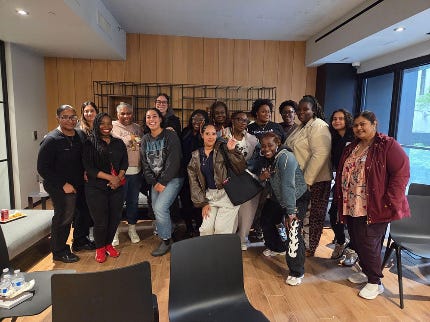
Stephania Zamorano, an assistant teacher at Imagine Early Learning Centers (Imagine), has been an educator for 15 years. Over half that time has been spent at two childcare centers: Bright Horizons and Imagine. After leaving Bright Horizons for Imagine, Zamorano says she is getting paid more and has less stress: “I don’t feel drained. I don’t feel like I’m coming into a heavy environment where I have to take more on my shoulders.”
Bright Horizons is a corporate childcare chain owned by Bain Capital, a private investment firm, before it went public in 2013. Imagine is a privately owned childcare organization with centers across New York City. It is also the only childcare organization in the country that is a 100% employee-owned company. Private equity investors approached the founder of Imagine with acquisition offers, CEO Laura Tulchin shared with me, but Imagine founder Holly Saltzman chose to sell the company to its employees through an Employee Stock Ownership Plan (ESOP).
Imagine is growing, expanding from 12 to 14 centers in 2026, with 81% of its teachers saying they plan to be at Imagine in two years. But if employee-owned daycares like Imagine are going to compete with private equity, which today operates 10-12% of all daycares, they need support: expanded access to capital, creative real estate solutions, and shared back-end infrastructure.
“A textbook example of a broken market”
Former Secretary of the Treasury Janet Yellen has described the childcare industry as “a textbook example of a broken market.” Part of the problem, she argues, is that the price families pay doesn’t reflect the full value childcare creates. Research shows kids with access to quality care go on to more schooling and higher earnings, and underinvesting in care now means giving up a more productive workforce later. Childcare is critical to the health and future of people and communities.
But childcare is also labor-intensive and low-margin. Labor makes up 70 to 80% of the cost to run a childcare business, making the service unaffordable for many: in 2024, a family needed an income of at least $187,000 to cover the $13,128 average national price for one child. Families in areas across the country spend more on childcare than on housing. To make care even remotely affordable for families, providers pay low wages, and highly trained staff often make less per hour than workers at McDonald’s.
Financializing a broken market
Thirty percent of childcare centers are independent for-profits, and for owners who want to retire, private equity can seem like the only option. Today, of the 10 largest childcare companies in the U.S., eight are currently owned by private equity investors, and private equity has steadily claimed roughly 10% of the American market since 2010.
One driver has been the allocation of public funds to the sector in states including New York, New Mexico, Massachusetts, and Colorado. This increase in public funding has attracted investors seeking buyout targets with guaranteed revenue. The situation mirrors the conditions known to draw investors to healthcare and elder care businesses: consistent, high demand paired with federal and state funding.
Community Change, National Women’s Law Center, Open Markets Institute, and Americans for Financial Reform Education Fund compiled a recent report on private equity and childcare. While the report is focused on childcare, its authors look to outcomes in other industries like elder care and health care that have seen heavy private equity investment as a warning sign for where childcare is headed: “well-documented experiences from the other industries that have seen significant private equity investment … show that private equity-owned businesses are more likely to push down the quality of the services they provide, the wellbeing of their customers and workers, and the competitive health of local markets.”
The possibility of employee ownership
That gap between what families can afford and what the people providing the care are paid is where employee ownership can be most powerful. In a market where families have limited choice and many businesses are privately run, employee ownership not only protects the business, but it gives the people doing the work a stake. Instead of handing ownership to investors far away from the communities where their portfolio companies are based, employee-owned companies also keep jobs and assets local.
All this was true for Imagine. The ESOP model was a way for the founder to reward the people who made the company successful while ensuring the business remains a resilient, stable childcare company rather than one focused on short-term profits and external shareholders.
Workers’ experiences at the company have been positive as it has transitioned to 100% employee ownership. Educator salaries range from $37,000 to $90,000 depending on seniority and tenure. While the wages are similar (in some cases higher) to pay at other centers, the ESOP layers a wealth asset on top of that pay. According to Imagine leadership, employees at Imagine have ESOP account balances ranging from $1,484 to $167,000. The shares increase with tenure and company growth. As of right now, the company is performing well, expanding from 12 to 14 centers in 2026. Specifically, Imagine was recently awarded a contract for The Little Apple, New York City’s first free, full-day, year-round childcare pilot program for municipal workers.
Imagine employees report that the ESOP education programs the company implemented have helped staff actually understand what ownership means in practice. In an interview, one teacher described going from “whatever, I don’t own anything” to feeling like “you’re the CEO of the place you’re at” after going through training. And workers report that they're given more control over their work, that they have a voice in the direction of the company, feel trusted in curriculum development, and are given a credit card to make direct purchasing decisions for classroom supplies.
According to Imagine’s annual employee survey, 83% of staff report being satisfied with their jobs, and 81% of staff say they see themselves working at Imagine in two years. All of these outcomes align with the benefits that employee ownership advocates and researchers promote.
What the industry needs from donors, investors, and policymakers
Imagine’s employee ownership success story didn’t come easy. If advocates want employee ownership to become a viable alternative to private equity ownership, especially in childcare, the industry needs more support, starting with access to financing that doesn’t depend on the original owner absorbing the risk alone. In the case of Imagine, the founder is holding the majority of the debt so as not to overload the business with high-interest loans.
To advance employee ownership in human services industries like childcare, employee ownership advocates and developers need to work in tandem with the government to make more shared ownership possible. Three solutions would support that expansion across the childcare industry:
Access to Capital. Investor-backed childcare providers have access to large amounts of financial capital, especially from debt. Private and employee-owned centers can’t easily compete for that same capital, in part because traditional lenders require personal guarantees that low-wage childcare workers are poorly positioned to offer, and because thin margins make these deals less attractive to lenders weighing them against higher-yield loans. To create a level playing field, community development financial institutions and other mission-driven lenders need to originate more debt for childcare conversions. Impact investors are already showing they’ll supply that kind of capital: Impact Charitable’s Catalytic Capital Partners, established in 2023 in partnership with Mission Driven Finance, has deployed over $16 million in impact-first investments, integrated capital funds, and flexible grants. These funds haven’t gone toward an employee ownership conversion yet, but they have supported the childcare space and provide an example of how mission-driven capital is already moving through structures that could support an employee-ownership conversion.
Additionally, de-risking tools could make lenders willing to say yes: loan loss reserve funds that spread default risk across a lending pool, collateral support programs that offset the guarantee gap like those the State of Colorado offers, and revenue-based financing structures that convert to worker ownership over time instead of requiring debt upfront.
A Solution to the Real Estate Problem. Childcare providers name real estate as one of the biggest barriers to growth. To make it easier for providers to access space for their businesses, groups like Mission Driven Finance are standing up programs like Care Access Real Estate (CARE). CARE acquires and develops child care facilities, then leases them to experienced operators through long-term agreements. This establishes and protects purpose-built facilities for providers that enable stable occupancy and predictable income.
Shared Infrastructure. Investor-backed childcare benefits from centralized business operations like accounting, marketing, procurement, and human resources. More shared services platforms need to be developed to limit overhead on childcare providers. CoRise is a great example of what this could look like. CoRise Cooperative helps home-based child care providers form cooperative networks for shared purchasing. The core project, CoRise Illinois, is a partnership between The ICA Group and SEIU-HCII (a union representing 35,000+ child care providers in the Midwest). More investment needs to be made to fully build out large-scale shared services that multiple childcare centers can leverage across the employee ownership types, and more work could be done to take advantage of the scale that unions offer to expand this work.
Imagine’s success shows the model works, but it worked because the founder absorbed the debt herself, sparing the business from high-interest loans. That’s not a repeatable condition; most retiring owners don’t have the option to finance their own employees’ buyout. Access to capital, real estate solutions, and shared services infrastructure are what make that choice available to the next owner, and the one after that.
Employee ownership can be a viable option for the childcare industry, but only if they have the financial infrastructure to compete on the same terms. Imagine is proof of concept. The test is whether the field can build the infrastructure to repeat it.
This story builds on earlier reporting for The74 that examined how employee ownership could improve worker retention in childcare in New York City.
A stake on paper isn’t enough if the residual claim still has to fight a financing and facilities stack built for a different kind of owner. The question isn’t whether employee ownership can “compete with PE” in the abstract. It’s whether we build the boring infrastructure — patient capital, property structures, shared services — that makes a second and third Imagine possible.
Curious what you’ve seen work for EO childcare on the real-estate piece specifically.
Employee ownership is a decent idea but very well roadblocked.
We like the idea better of community PMA’s
Like so
https://joshketry.substack.com/p/the-blueprint-for-a-parallel-society?r=7oa9d&utm_campaign=post&utm_medium=web